Summarize this blog post with:
Introduction: The Real PMS Test Begins When the Portfolio Grows
For a single hotel, a PMS buying decision can reasonably focus on reservations, front desk, housekeeping, distribution, payments and reporting. For a growing hotel group, that checklist is no longer enough.
The more revealing question is: what happens when Hotel #11 joins a 10-property group?
Does the new property simply get another PMS account, or can it become part of the group’s existing operating model—its guest and company profiles, purchasing structure, financial controls, reporting, service standards and management visibility?
That distinction matters when comparing mycloud PMS and eZee Absolute/YCS. Both platforms cover core PMS, distribution, POS and multi-property requirements, so the meaningful difference is not simply “integrated versus non-integrated.” The stronger distinction lies in the breadth of the operating layer. mycloud PMS brings PMS/CRS, centralized profiles, back-office purchasing, inventory, costing and accounting, together with dedicated guest-service workflow management into a broader operational environment. This becomes particularly relevant for growing hotel groups looking to centralize more than just reservations, rates and room inventory.
For owners, Group GMs, COOs, CFOs and CIOs of small-to-mid-sized hotel groups, this changes the evaluation. Instead of asking which platform has more features, ask:
Which platform makes it easier to add hotels without multiplying operational complexity?
mycloud PMS vs eZee Absolute at a Glance
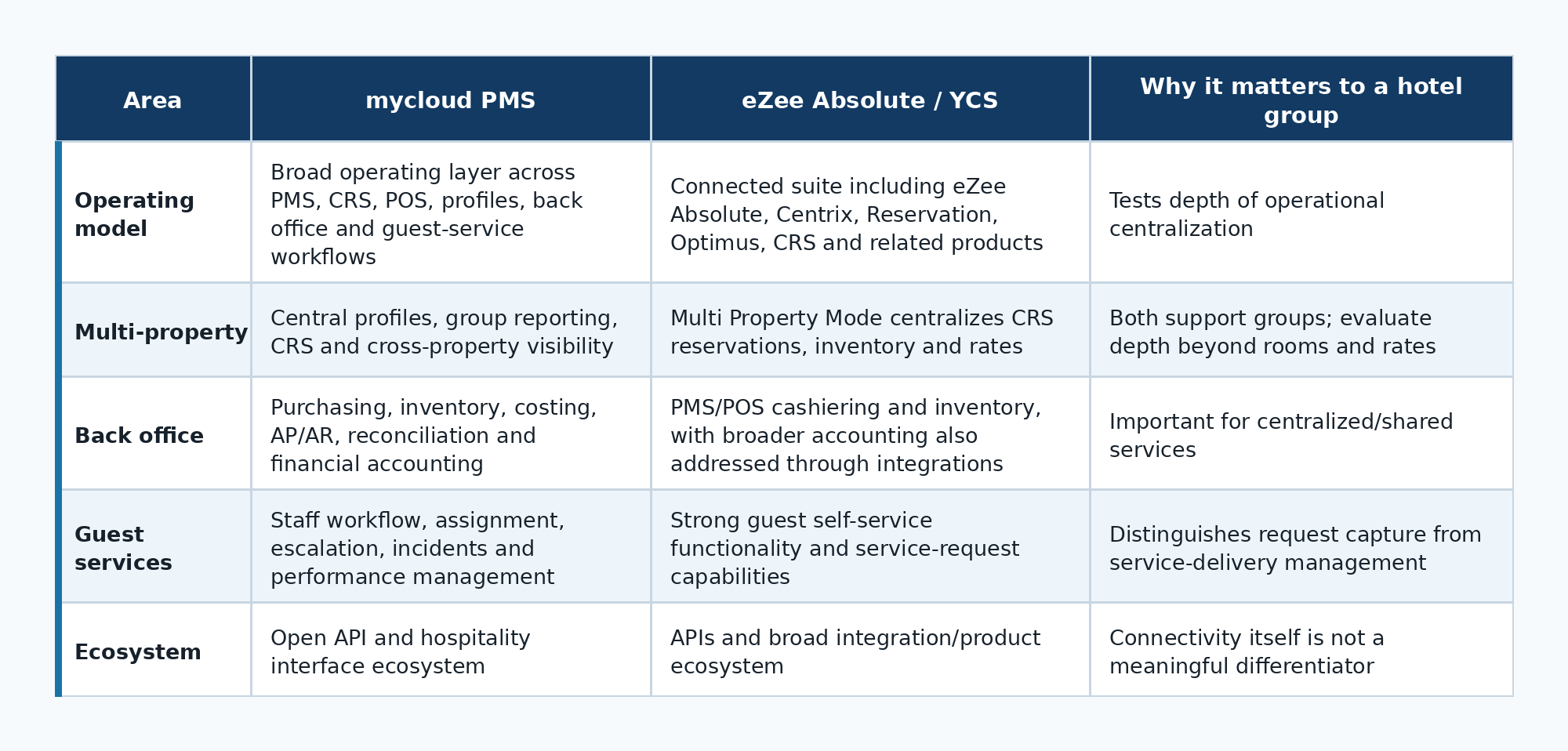
These distinctions reflect the evidence summarized in the September 2026 comparison brief.
1. A Hotel Group Needs More Than Multi-Property PMS
“Multi-property” has become a standard term in hotel technology, but it can describe very different levels of centralization.
At the first level, a group may centrally see reservations, availability and rates. At a deeper level, the group can share guest and company profiles and analyze performance across properties. At an even deeper operational level, centralization extends into purchasing, inventory, finance, costing and guest-service delivery.
This is an important distinction between the two platforms.
mycloud PMS: extending centralization into the operating model
mycloud PMS publicly describes central profiles, group reporting, CRS and property-to-property operational visibility. More importantly for a growing group, its operating layer extends into back-office and guest-service workflows.
That can support a shared-services approach.
Imagine a group operating 12 hotels under three brands. Instead of every hotel independently maintaining all accounting and administrative expertise, selected functions can potentially be pooled centrally. Skilled finance resources can oversee areas such as creditors, debtors, reconciliation and financial reporting across the portfolio, while properties concentrate on guest-facing operations.
This is where PMS architecture begins affecting corporate overhead—not merely IT.
eZee Absolute/YCS: increasingly centralized multi-property management
It would be inaccurate to describe eZee as simply a property-by-property PMS. The research specifically warns against that characterization.
Its Multi Property Mode centralizes CRS reservations, inventory and rates, while cross-property analytics and messaging capabilities are being expanded.
The more useful comparison for a chain buyer is therefore:
How far does centralization extend beyond reservations, rates and inventory into the group’s complete operating model?
That is a much stronger evaluation criterion than whether both products have a “multi-property” checkbox.
2. Back Office: Where the Difference Becomes More Significant
Front-office functionality is visible. Back-office complexity often isn’t—until the portfolio grows.
A new property does not only add rooms. It adds vendors, purchase orders, inventory movements, receivables, payables, bank reconciliation, F&B costing and financial controls.
mycloud’s back-office capabilities cover purchasing, supplier rate contracts, receiving, inventory, F&B costing, works orders, sales/detors ledger, purchase/creditors ledger, bank reconciliation and financial reporting. The analysis also notes a chain deployment where integrated materials and financial accounting supported shared services across properties.
For a small-to-mid-sized hotel group, this creates an important strategic possibility: centralize expertise rather than duplicate expertise.
A highly experienced accountant, purchasing specialist or finance controller is a scarce resource. A technology architecture that supports centralized administration can allow that person to oversee multiple properties rather than requiring every hotel to recreate the same administrative structure.
eZee/YCS has strong PMS cashiering and restaurant stock/inventory functionality. The research recommends that chain buyers specifically validate the depth of native centralized purchasing, AP/AR, financial accounting, F&B costing and shared-service workflows versus third-party accounting integrations during evaluation.
This leads to a useful question for a CFO:
Can the same hotel technology environment that knows what we sold also manage what we bought, consumed, owe and reconcile across the group?
3. The Hotel #11 Test: Scaling the Operating Model, Not Just the PMS
This may be the most useful test for senior decision-makers.
Assume your group already has 10 properties and acquires Hotel #11.
Both systems can accommodate another property. But that does not tell you how much work is involved in making Hotel #11 operate like the other ten.
mycloud’s chain material emphasizes standardization and centralization. The research also records a TGI example stating properties could go live in as little as four hours, while eZee’s published onboarding process states 3–5 days beginning with property-data collection and account configuration. These figures should not be treated as an apples-to-apples implementation benchmark because scope and conditions may differ; the more useful question is how much existing group configuration can actually be reused.
For Hotel #11, management should test whether it can reuse or inherit the group’s:
- guest, company and travel-agent structures;
- market segments, business sources and payment types;
- chart of accounts and financial structure;
- purchasing and inventory categories;
- vendor and approval structures;
- F&B costing model;
- guest-service categories, SLAs and escalation rules;
- group reports and BI views.
The brief makes the same recommendation: determine what is inherited or copied from the chain model versus what must be configured again by the implementation team.
That is the difference between scaling software and scaling an operating model.
4. Guest Self-Service vs. Guest-Service Delivery Management
Digital guest experience is another area where superficially similar capabilities can solve different problems.
eZee’s Guest Self-Service offering provides substantial guest-facing functionality. Publicly documented capabilities include profile creation, self check-in/check-out, service requests, transport requests, billing, cashless payments, booking changes, feedback and time-based request history.
That addresses an important question:
How easily can the guest request something?
mycloud PMS Guest Services goes deeper into what happens operationally after the request arrives. Its documented service-management workflow includes request logging, staff assignment, recurring tasks, automatic assignment, alerts and reminders, up to three escalation levels, out-of-office routing, follow-up, incident tracking, cost recovery, call queues, PMS guest lookup, audit trails and staff/department performance statistics.
For a hotel group, this distinction matters.
Suppose a guest requests an airport transfer at Hotel A and maintenance assistance at Hotel B. Capturing those requests digitally is useful. But corporate operations may also want to know:
Who received the request? How quickly was it assigned? Was the SLA breached? Was it escalated? How long did resolution take? Which departments repeatedly miss service targets?
That moves guest-service technology from request capture to service-delivery management.
For groups trying to standardize service across brands and properties, the latter can become a management tool rather than merely a digital convenience.
5. Centralized Guest Data: Look Beyond the “Single Guest Profile” Claim
Both platforms provide guest profiles and group/CRS functionality, so simply claiming that one has guest profiles and the other does not would be misleading.
Hotel groups should instead test the operational depth of guest data.
A returning guest who stayed at Mumbai last month and Pune this month should not merely exist in both systems. The useful questions are whether teams can recognize the guest’s history, how duplicate profiles are governed, which information is available across properties, and how corporate standards around guest data are maintained.
This becomes increasingly important as hotel groups pursue personalization and AI. AI is only as useful as the operational context available to it. Fragmented or duplicated guest records can weaken recommendations regardless of how sophisticated the AI layer becomes.
The buying criterion should therefore shift from:
“Does the PMS have guest profiles?”
to:
“How effectively does the group govern and use guest context across its portfolio?”
6. Integrations Matter—but API Availability Is Not a Differentiator by Itself
Hotel groups will always need external technology: RMS, payment gateways, identity systems, CRM, loyalty, specialized analytics and other applications.
Both platforms are integration-capable. mycloud PMS positions an Open API and a large hospitality interface ecosystem, while eZee/YCS provides connectivity APIs and a broad product/integration ecosystem. The analysis explicitly rates API availability alone as a low-value competitive differentiator.
That is an important point for technology leaders.
Having 200 integrations is less meaningful than understanding where integrations are actually required.
If fundamental hotel operations require multiple applications to exchange transactions continuously, integration becomes part of everyday operational dependency. If the core operating layer already covers more functions natively, APIs can instead be reserved for specialist technologies where best-of-breed applications add genuine value.
A CIO should therefore ask not only “How many APIs do you have?”, but “How many interfaces will our group depend on every day to complete one end-to-end business process?”
7. Reporting: Central Visibility Should Follow the Operating Model
A 15-property group does not simply need 15 sets of reports accessible from corporate headquarters.
It needs group-level information that allows management to compare properties using consistent definitions.
For example, a Group CFO should be able to understand revenue and financial performance without teams spending hours reconciling different definitions or manually rebuilding corporate reports. Operations leadership should similarly be able to compare service performance across hotels.
The analysis describes central profiles, group reporting, CRS and cross-property visibility for mycloud, while eZee’s Multi Property Mode centralizes important reservations, rates and inventory functions and is expanding cross-property analytics.
For decision-makers, the evaluation should go beyond asking whether a dashboard exists. Ask whether Hotel #11 automatically becomes part of established group reports, financial views and BI dashboards, or whether corporate reporting requires additional configuration.
mycloud PMS vs eZee Absolute: Where the Practical Difference Lies
There is no value in presenting this comparison as “integrated versus disconnected” or “multi-property versus single-property.” Current evidence does not support either characterization.
eZee Absolute/YCS is a connected hospitality technology suite with multi-property capabilities, distribution, POS, inventory, APIs and increasingly centralized group functionality. For many independent hotels and hotel groups, that breadth may fit their requirements.
mycloud PMS’s more meaningful differentiation for a growing hotel group is the depth of the operating layer surrounding the PMS: centralized profiles and CRS combined with purchasing, inventory, costing, financial accounting and dedicated guest-service delivery workflows. The assessment identifies back office and guest-service management as two of the clearest areas for chain buyers to investigate.
For senior decision-makers, the decision therefore becomes less about comparing two feature matrices and more about deciding how the hotel group itself should operate as it grows.
A useful final test is simple:
When Hotel #11 opens, how much of the operating model of Hotels #1–10 comes with it?
A hotel chain PMS should not merely make it possible to add another property. It should make it easier to add that property without duplicating the operational complexity that already exists across the group.
Editorial disclosure
mycloud Hospitality publishes this guide and is included in the comparison. Competitor descriptions are based on publicly available product information accessed from official sources. The article does not constitute a universal ranking. Product capabilities, pricing and availability may change, and hotels should verify current information directly with shortlisted vendors.

About The Author

Deepak Chauhan
Deepak Chauhan is responsible for marketing and positioning of “mycloud” platform and is a veteran in the hotel software industry with over 25 years’ experience giving him a strong understanding of the product requirements in the industry. He has very rare mix of working in operations of various hotels and chains for over 10 years and then co-founding a software product and service company, servicing 5 star hotels and chains for 14 years.
Deepak has led the development and marketing of cloud based hospitality systems to meet the specific, business objectives of small and mid-size properties across the globe and has worked closely with a diverse group of hoteliers and hotel technology vendors.