Summarize this blog post with:
Two hotels open on the same street. Same room count, same city, same starting ADR. Twelve months later, one is quietly outperforming its market by double digits, while the other is still discounting rooms on a Tuesday afternoon and wondering why. The rooms didn’t change. The location didn’t change. What changed was the system running underneath the business.
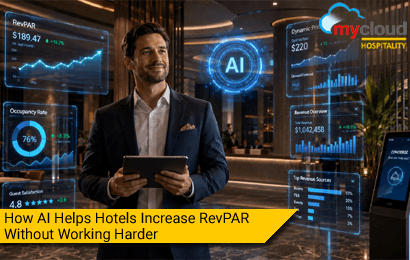
Here’s the number worth remembering before anything else: hotels that adopt AI-driven pricing and automation typically see RevPAR gains of 15–25% within six to twelve months, according to multiple 2026 hospitality industry studies. That single figure — repeated across independent case studies, revenue management vendors, and hospitality analysts — is the clearest evidence yet of what this article calls the AI profit gap.
The AI profit gap is the widening difference in profitability between hotels that use an AI-enabled hotel management system to automate pricing, guest communication, and staffing decisions, and those still running on spreadsheets, gut instinct, and manual processes. It isn’t about having flashier technology. It’s about the compounding cost of slower decisions, in a business where margins are thin and decisions happen every hour.
This article breaks the gap into four buckets that decide who wins it: pricing and revenue management, labor efficiency, direct bookings versus OTA dependency, and guest response speed. By the end, you’ll have a way to measure where your own property stands — and what closing that gap actually requires.
What Is the “AI Profit Gap” in Hospitality?
The AI profit gap is the measurable difference in RevPAR, labor cost ratio, and direct booking share between hotels using AI-powered hotel software to automate decisions and hotels relying on manual, reactive processes. It shows up not as one dramatic failure but as dozens of small, missed decisions compounding over a year.
The gap is widening for three structural reasons. First, labor costs are climbing faster than revenue — U.S. hotel wage cost per occupied room rose 12.8% in 2025, even as topline growth stayed flat in many markets. Second, OTA commissions continue to eat into margin, typically running 15–25% per booking, and sometimes higher once preferred-placement fees are added. Third, guest expectations have shifted permanently: travelers now expect an answer to a late-night inquiry in minutes, not the next business day, and a hotel management system without automated guest communication simply cannot meet that bar at scale.
The Two-Hotel Comparison: A Year in the Life of Two Similar Properties
Consider Hotel A and Hotel B — both 60-room independent properties in the same secondary city, opening with near-identical ADR and occupancy in January.
Hotel A runs on a modern hotel management system with AI-assisted pricing, an integrated booking engine, and automated guest messaging. Hotel B runs on a legacy PMS, a shared spreadsheet for rates, and a front desk team that also answers email and social media inquiries whenever they get a free moment.
By March, the gap is barely visible. By July — peak season — it isn’t. Hotel A’s pricing engine catches a local conference booking surge overnight and adjusts rates before the market corrects itself; Hotel B’s revenue manager notices the spike two days later, after most of the compression has already been sold at yesterday’s rate. Hotel A’s automated messaging answers a 11 p.m. inquiry about late check-in in under a minute and converts it to a direct booking; Hotel B’s same inquiry sits in an inbox until 9 a.m., by which point the guest has booked elsewhere. Hotel A’s front desk team, freed from manual rate updates and repetitive email replies, spends more time upselling breakfast packages and late checkout.
By December, Hotel A is running noticeably ahead on RevPAR, carrying a lower labor cost as a share of revenue, and sourcing a meaningfully higher share of bookings direct rather than through commission-heavy OTAs. None of this came from a single dramatic decision. It came from hundreds of small, faster decisions across the year — the compounding effect of running on the right hotel software instead of reacting after the fact.
Where the Profit Gap Actually Comes From
Dynamic Pricing & Revenue Management
The pain point is familiar to almost every independent hotelier: rates get set once a week, based on gut feel and last year’s numbers, and demand spikes get noticed only after they’ve already passed. A revenue manager juggling spreadsheets across multiple channels simply cannot reprice fast enough to capture every surge.
AI-driven pricing inside a hotel management system solves this by continuously analyzing demand signals — search trends, competitor rates, booking pace, local events — and adjusting prices in near real time, sometimes multiple times a day rather than once a week.
Stat callout: Hotels adopting AI-assisted dynamic pricing report RevPAR increases of 15–25% within six to twelve months, with some properties reporting gains as high as 30–35% depending on their starting point. The same automation frees up an estimated 20–30 hours a month that revenue managers previously spent on manual rate updates.
Labor Cost & Staff Efficiency
Independent and boutique hotels typically run lean teams doing double or triple duty — the same person handling check-in, phone inquiries, and social media messages. Every manual, repetitive task pulled onto that person’s plate is time not spent on the guest standing in front of them.
Hotel labor cost per occupied room rose 12.8% in the U.S. in 2025 alone, and industry surveys show a majority of hotels operating short-staffed in frontline roles. Automating repetitive back-office work — rate updates, routine guest replies, report generation, housekeeping assignment — doesn’t replace staff; it reallocates their time toward the guest interactions that actually drive upsells, reviews, and repeat stays.
Direct Bookings & OTA Commission Savings
OTA commissions typically range from 15% to 25% per booking, and can climb higher with preferred-placement programs. For an independent hotel, that’s a substantial and recurring cut of revenue on every reservation that didn’t have to go through a third party.
A modern hotel management system with an integrated booking engine and instant guest-response automation captures more of that demand directly. When a guest finds your website, asks a question, and gets an immediate, accurate answer, there’s far less reason for them to bounce over to an OTA and book at a commission cost to your property.
Guest Response Speed & Conversion
This is where the gap becomes painfully visible. The classic scenario: a guest messages at 11 p.m. asking about availability or a late check-in; the reply arrives at 9 a.m. the next day. By then, the guest has usually booked somewhere else.
Research across the hospitality sector shows that improving response rates from roughly 89% to 100% has been associated with booking increases as high as 116%, and hosts who reply within an hour see about 25% more instant bookings than those who don’t. Speed isn’t a nice-to-have anymore — it’s a conversion mechanism, and it’s one of the clearest, most immediate wins available to any hotel software upgrade.
AI-Enabled Hotels vs. Manual-Process Hotels: The Metrics Side by Side
Line up the two operating models against the metrics that matter most, and the pattern holds across nearly every independent study published in 2025–2026:
- RevPAR growth (6–12 months): AI-enabled properties typically post gains of 15% to 25%, while manual-process hotels tend to stay flat or move up only in the low single digits.
- Labor cost as a share of revenue: Automation reallocates hours toward guest experience and upsells; manual processes keep that time absorbed by repetitive administrative tasks, pushing the labor cost ratio higher.
- Direct booking share: Instant, automated response supports a higher share of direct bookings; slower manual reply times push more of that demand toward OTAs and their commissions.
- Average guest inquiry response time: Automated systems respond in minutes, any time of day; manual teams often take hours, sometimes stretching to the next business day.
- Manual pricing hours per month: AI-assisted pricing cuts this workload by an estimated 20–30 hours a month; fully manual pricing keeps that workload in place indefinitely.
(Figures reflect ranges reported across independent 2025–2026 hospitality industry studies; individual results vary by market, property size, and implementation.)
Myth vs. Reality: Addressing the Trust Gap
Myth: “AI pricing means I lose control of my rates.” Reality: A good hotel management system lets you set pricing guardrails — floors, ceilings, and approval rules — while the AI handles the moment-to-moment adjustments within them.
Myth: “This is only for large chains with dedicated revenue teams.” Reality: Independent and boutique hotels often see the biggest relative gains, precisely because they don’t have a full-time revenue manager watching rates around the clock.
Myth: “Automated guest replies feel robotic and hurt the guest experience.” Reality: Automation handles the instant acknowledgment and routine questions; your team still owns the personal touches that matter, just with less noise competing for their attention.
Myth: “Switching hotel software is disruptive and takes months.” Reality: Modern cloud-based systems are built for fast onboarding, with most properties live within days to a few weeks, not quarters.
Myth: “We’re too small to need a hotel management system with AI features.” Reality: The profit gap tends to hit smaller, leaner-staffed properties hardest, since they have the least slack to absorb slow manual processes.
Does Hotel Size Change the Profit Gap?
Independent and boutique hotels feel the gap most acutely in labor efficiency and response speed — with no dedicated revenue or reservations team, every manual task directly steals time from guest-facing work.
Mid-size chains typically feel it most in pricing consistency across properties — without automation, rate strategy quality varies property to property depending on who’s running it.
Large hotel groups feel the gap in scale and reporting — manual processes that cost a few hours per property multiply into hundreds of lost hours and inconsistent guest experience across a portfolio.
The 5-Minute Profit Gap Self-Check
Ask yourself honestly:
1. How often do you update room rates — daily, weekly, or only when someone remembers to?
2. What’s your average guest inquiry response time outside business hours?
3. What percentage of your bookings come through OTAs versus your own direct channel?
4. How many hours does your team spend each week on manual rate updates or repetitive replies?
5. Do you know your current RevPAR trend versus your comp set, in real time?
6. If a demand spike happened tonight, would your pricing catch it before tomorrow morning?
If more than two of these gave you an uncomfortable answer, you’re likely sitting inside the profit gap right now.
How to Start Closing the Gap
Closing this gap doesn’t require ripping out every system overnight. Start with an audit: pull your last three months of rate changes and see how often they lagged actual demand. Test automated acknowledgment on your guest messaging for one week and track how many after-hours inquiries convert. Compare your OTA share and blended commission cost against your direct booking share.
This is exactly the set of problems a unified hotel management system is built to solve — connecting pricing, distribution, and guest communication into one platform instead of three disconnected tools. mycloud PMS is built around these four buckets specifically: AI-assisted pricing recommendations, an integrated booking engine to protect direct revenue, automated guest communication tools, and reporting that shows your RevPAR and labor efficiency trends in one view — so hotel owners and operators can see, in real numbers, where their property sits against the gap.
Conclusion
The gap between Hotel A and Hotel B was never about location, room count, or brand — it was about the speed and quality of everyday decisions, repeated hundreds of times over a year, and a 15–25% RevPAR difference is what that adds up to. The tools to close that gap are no longer reserved for large chains with dedicated revenue teams; they’re available to any independent or boutique property willing to run the five-minute self-check above and be honest about the answers. Where your hotel lands a year from now depends less on the market you’re in, and more on the system you’re running today.

About The Author

Deepak Chauhan
Deepak Chauhan is responsible for marketing and positioning of “mycloud” platform and is a veteran in the hotel software industry with over 25 years’ experience giving him a strong understanding of the product requirements in the industry. He has very rare mix of working in operations of various hotels and chains for over 10 years and then co-founding a software product and service company, servicing 5 star hotels and chains for 14 years.
Deepak has led the development and marketing of cloud based hospitality systems to meet the specific, business objectives of small and mid-size properties across the globe and has worked closely with a diverse group of hoteliers and hotel technology vendors.