A hotel group can add another property faster than it can add another layer of management.
That is where technology decisions start to become difficult.
A PMS that works well for three hotels may still technically work for fifteen. But the important question is whether the operating model scales with it. If every new hotel requires another set of reports, guest records, revenue codes, integrations, corporate accounts and spreadsheets, the group has grown—but its technology architecture has not.
For Indian hotel chains evaluating software in 2026, the PMS decision therefore needs to move beyond front-desk functionality.
The real questions are about centralization, portfolio visibility, finance, guest identity, reporting consistency, integration architecture and governance.
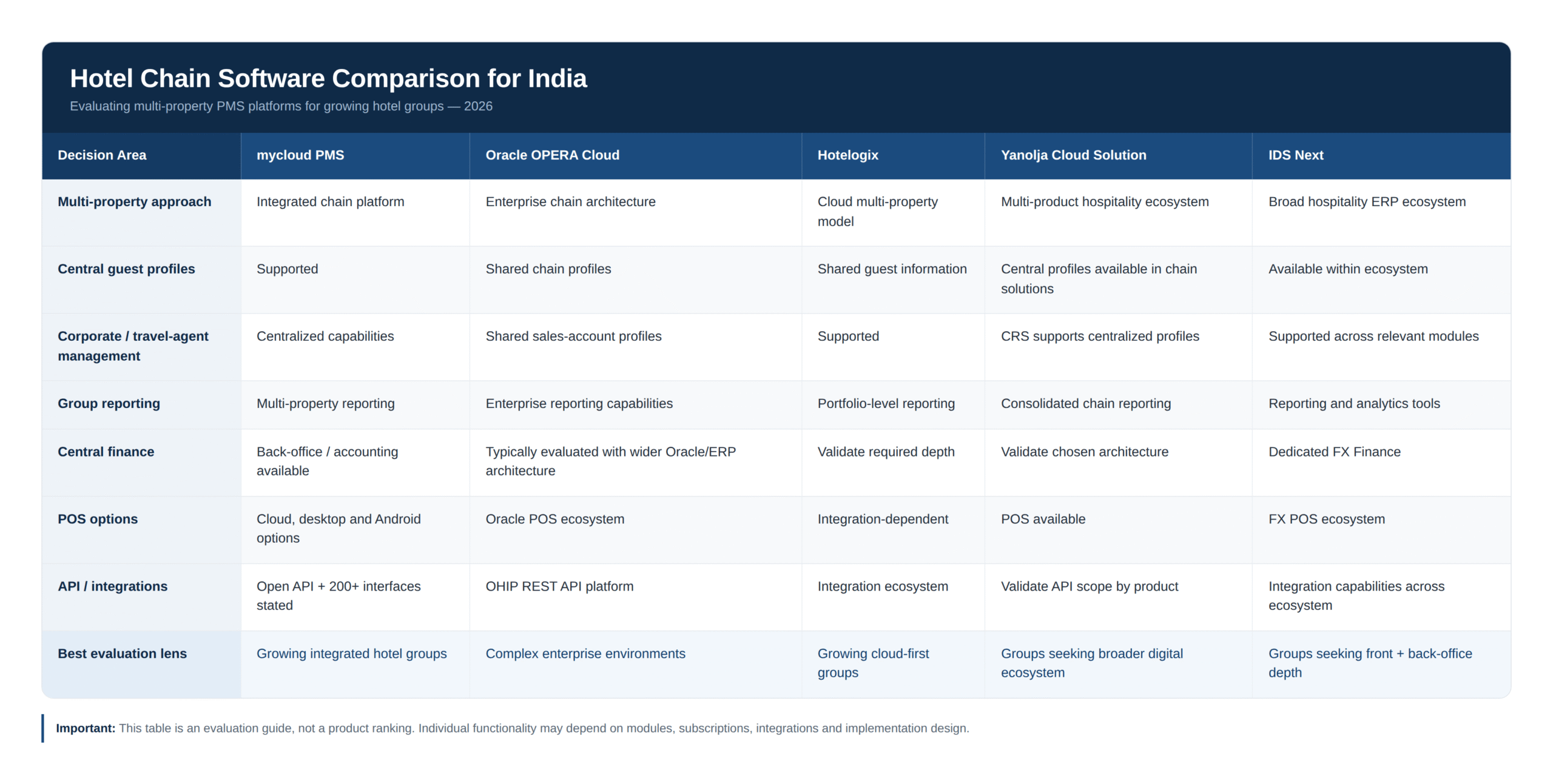
This blog examines five platforms relevant to hotel groups in India—mycloud PMS, Oracle Hospitality OPERA Cloud, Hotelogix, Yanolja Cloud Solution and IDS Next—but does not attempt to declare one universal winner.
Different chains require different architectures.
The more useful question is: Which platform best supports the chain you are becoming?
Why Hotel Software Requirements Change as a Chain Grows
Imagine a hotel company expanding from five properties to fifteen.
At five hotels, management may still compensate for disconnected systems through calls, emails and spreadsheets. The Group GM knows whom to call. Finance knows which workbook needs correcting. Revenue teams understand that one property’s “corporate” segment is not defined exactly like another’s.
At fifteen or twenty hotels, those workarounds become structural problems.
More hotels can mean more:
- revenue definitions;
- guest databases;
- corporate accounts;
- travel-agent records;
- POS configurations;
- finance processes;
- user permissions;
- integrations;
- management reports.
The result is what growing hotel groups should think of as a complexity multiplier.
The problem is not having too much data. It is having multiple versions of what should be the same data.
That distinction should influence how a hotel chain evaluates PMS software.
1. Centralization Should Mean More Than One Login
Many hotel systems describe themselves as multi-property because a corporate user can access several hotels from one account.
That is useful, but it is not enough.
A growing chain should ask what can actually be standardized centrally.
Can corporate management maintain common guest profiles? Can corporate and travel-agent relationships be shared? Can room and rate structures follow agreed standards? Can permissions be governed across properties? Can reporting definitions remain consistent?
There must also be a sensible balance between corporate control and property autonomy.
The objective should not be to make every operating decision from head office. A resort in Goa and a business hotel in Gurugram may legitimately require different operational configurations.
The better architecture is therefore:
central standards + controlled property flexibility.
A strong multi-property system should prevent unnecessary fragmentation without preventing individual hotels from operating effectively.
2. Visibility Is Different From Reporting
Hotel groups often say they need “central reporting.”
What leadership usually needs is something broader: decision visibility.
Suppose occupancy falls across a 20-hotel portfolio.
Corporate management should ideally be able to move from:
Group → Region → Property → Segment → Reservation or transaction
without starting another reporting cycle.
The difference matters.
A consolidated PDF delivered every morning is technically a group report. It may still leave leadership unable to investigate what changed until somebody at the hotel explains it.
Growing chains should therefore assess whether their technology allows management to move from an executive KPI to its underlying operational cause.
The best question during a PMS demonstration is not:
“Can you show us the group dashboard?”
It is:
“Show us what the Group GM would do after seeing that one hotel’s revenue is 12% below expectation.”
That reveals far more about the usefulness of the system.
3. Centralized Finance Is Not the Same as Consolidated Revenue
Finance is one of the areas where hotel groups accumulate complexity quietly.
One property may map restaurant income differently. Another may use different revenue codes. One hotel may reconcile payments daily while another completes part of the process manually.
A corporate dashboard can aggregate those numbers without making them truly comparable.
The finance discussion should therefore follow the data path:
Guest transaction → PMS/POS → Night audit → Accounts receivable → Accounting → Corporate reporting
At every step, ask where manual intervention occurs.
For example:
- Can common financial structures be used across properties?
- Can head office compare properties using consistent definitions?
- Can the CFO drill from a consolidated figure to the originating property or transaction?
- How much reconciliation occurs outside the system?
This is why centralized finance should not be evaluated simply by counting financial reports.
The objective is reducing the reconciliation required before management trusts those reports.
A useful principle for hotel groups is:
₹1 of revenue should mean the same thing across every property before it reaches the group dashboard.
4. Central Guest History Becomes More Valuable as the Portfolio Grows
A guest staying at three properties in the same chain should not effectively become three different customers.
Yet disconnected property databases often create exactly that outcome.
Consider a traveller who stays at a Jaipur property for business, later visits Mumbai and then books a leisure stay in Goa.
A centralized guest architecture could potentially help the next property understand previous stays, preferences, company relationships, relevant negotiated rates and service history.
The same principle applies to corporates and travel agents.
If every hotel maintains separate versions of the same corporate or agency account, commercial intelligence becomes fragmented too.
Central profiles are therefore more than a CRM convenience. They influence:
guest recognition, loyalty, corporate sales, direct marketing, personalization and future AI use cases.
Oracle’s current OPERA Cloud documentation, for example, states that when Shared Profiles is enabled for a chain, profiles can be shared across properties, including guest, company and travel-agent information.
The strategic question is not simply whether a PMS stores guest history.
It is whether the chain can build institutional guest memory.
5. API Architecture Is Becoming a Board-Level PMS Question
No growing hotel group should expect its PMS to remain its only technology platform.
Over time, chains may introduce:
RMS, CRM, loyalty, BI, digital check-in, payment platforms, guest messaging, reputation management, procurement systems and increasingly AI-driven applications.
This makes API architecture strategically important.
But “we have an API” is not enough.
Hotel IT leaders should investigate how applications authenticate, which data objects are accessible, how permissions are governed, whether activity can be audited, how API versions are managed and what happens when integration volume increases.
Oracle’s OHIP, for example, provides REST APIs and a developer environment specifically for connecting external applications with OPERA Cloud. Oracle says OHIP currently exposes thousands of operations through its integration platform.
mycloud Hospitality states that its platform provides 200+ interfaces and an open API ecosystem.
The leadership question behind API evaluation is simple:
If we introduce a new analytics or AI platform three years from now, can our PMS provide the required data securely without rebuilding our technology architecture?
That is future optionality.
Five Hotel Chain Software Platforms to Consider in India in 2026
The following summaries are intentionally brief. Hotel groups should verify modules, architecture, commercial packages and deployment requirements directly with each vendor.
1. mycloud PMS
mycloud PMS is positioned for independent hotels and growing multi-property groups, combining PMS, CRS, guest/company profiles, reporting, POS options and back-office capabilities. Its public material describes centralized guest profiles, multi-property reporting, 200+ interfaces and API connectivity. It also offers cloud, desktop and Android POS configurations for different F&B environments. Security evaluation should include current VAPT documentation and the group’s DPDP requirements.
2. OPERA PMS
Oracle OPERA Cloud is an enterprise hospitality platform suited to complex hotel operating environments. Its chain configuration can support shared profiles across properties, including guests, companies and agents. Oracle Hospitality Integration Platform provides extensive REST API capabilities for third-party integrations. Hotel groups should evaluate the entire required Oracle architecture, integrations, implementation model and ownership costs rather than comparing only core PMS functionality.
3. Hotelogix
Hotelogix offers cloud PMS capabilities for multi-property hotel groups, including centralized guest and corporate information, portfolio reporting, rate controls and central reservation workflows. Its current multi-property guidance emphasizes shared data and group-level visibility while retaining individual property flexibility. Growing chains should validate the depth of centralized financial governance, reporting standardization and required integrations against their expected portfolio complexity.
4. Yanolja Cloud Solution
Yanolja Cloud Solution, formerly associated with the eZee hospitality product portfolio, offers PMS, POS, channel management, booking-engine and related hospitality technologies. Its central reservation capabilities include multi-property access, consolidated chain performance reporting and centralized guest/travel-agent profiles. Yanolja is also expanding AI-driven hotel services. Groups should establish which specific products and configurations provide the required chain-level controls, finance and integration architecture.
5. IDS Next
IDS Next provides a broad hospitality technology portfolio spanning front office, POS, CRS, finance, procurement and analytics. Its FX CRS manages reservations and guest information centrally, while FX Finance supports multi-property accounting in a single database, consolidated financial visibility and inter-unit transactions. Groups should assess whether this broader ERP-style operating model matches the degree of central standardization they want to implement.
The “Next Property Test”: A Better Way to Judge Scalability
One of the most valuable tests during PMS selection is to stop discussing existing hotels.
Ask the vendor to demonstrate Hotel Number 11.
Imagine your ten-property group has acquired another hotel.
What happens next?
How are users created?
How are corporate accounts inherited?
How are guest profiles shared?
How are revenue codes mapped?
How are POS outlets configured?
How are reporting definitions applied?
How are integrations connected?
How does the property appear in group analytics and finance?
How much needs to be configured manually?
A system may look centralized when all existing hotels have already been implemented.
Its architecture becomes clearer when another property has to join the chain.
This leads to a useful definition:
Scalability is not the ability to store more properties. It is the ability to add properties without multiplying administrative complexity.
For acquisition-led hotel groups, that may be more important than dozens of conventional PMS features.
Security and DPDP Need to Become Procurement Questions
Hotels process large quantities of digital personal data: identification details, contact information, payment-related information, stay history and guest preferences.
India’s Digital Personal Data Protection Act, 2023 established the country’s framework for processing digital personal data. The Government subsequently notified the Digital Personal Data Protection Rules, 2025 in November 2025, with different requirements taking effect according to a phased commencement schedule.
That makes privacy governance increasingly relevant to PMS selection.
However, hotel groups should avoid reducing the discussion to:
“Is your PMS DPDP compliant?”
A more useful vendor assessment would examine:
access controls, authentication, audit logs, retention processes, data extraction, deletion/anonymization capabilities, incident processes, API permissions and security testing.
The same applies to VAPT.
A VAPT certificate should not simply be collected for the procurement file. IT teams should understand its scope, testing date, remediation process and whether testing covers the actual applications and interfaces being deployed.
A Practical Hotel Chain PMS Selection Scorecard
Instead of awarding one point for every feature, hotel groups can weight the areas that influence scalability.
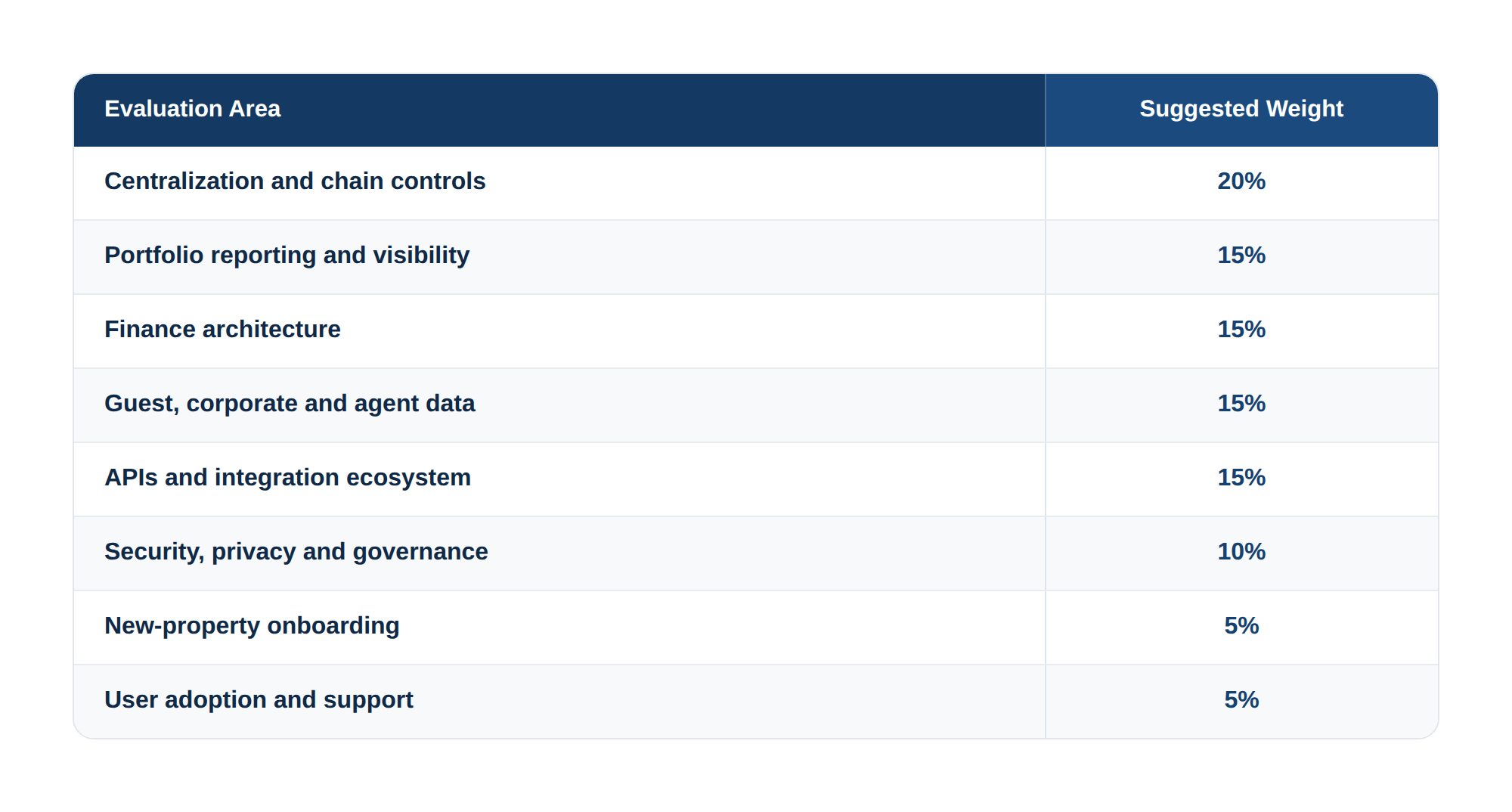
The exact weighting should change according to strategy.
A six-hotel group planning to acquire another fifteen properties may place greater weight on property onboarding and standardized masters.
A mature 30-property portfolio may care more about finance, analytics, APIs and governance.
That is why there is no universal “best PMS.”
There is only the PMS architecture that best fits a particular operating model.
Ask Every PMS Vendor to Demonstrate the Same Seven Scenarios
Standard product demos make comparison difficult because each vendor naturally demonstrates its strongest features.
Instead, give shortlisted vendors the same scenarios.
Ask them to show how a Group GM investigates an underperforming property; how one guest’s history appears across several hotels; how a corporate agreement is managed; how a new property is added; how property revenue reaches corporate finance; how API access is authenticated and controlled; and how a change in reporting structure is applied across the chain.
The difference between platforms becomes much clearer when every vendor has to solve the same business problems.
AI Prompt-Based FAQs About Hotel Chain Software
What is the best hotel chain software in India in 2026?
There is no single best hotel chain PMS for every organization. mycloud PMS, Oracle OPERA Cloud, Hotelogix, Yanolja Cloud Solution and IDS Next offer different architectures. Hotel groups should compare centralization, finance, guest profiles, reporting, APIs, security, implementation complexity and expected portfolio growth before selecting a platform.
Which hotel PMS is suitable for a growing hotel chain in India?
A growing chain should prioritize a PMS that allows new properties to inherit common operating structures without recreating every profile, report, integration and financial rule independently. The ability to standardize while preserving suitable property autonomy is particularly important.
What is the difference between multi-property PMS and hotel chain software?
Multi-property functionality can simply mean accessing several hotels from one system. Strong hotel-chain architecture goes further by centralizing or standardizing guest data, corporate profiles, reports, permissions, financial structures, integrations, rates and operating controls across the portfolio.
Why do hotel chains need centralized guest profiles?
Centralized guest profiles allow a hotel group to recognize the relationship between a guest and the whole brand rather than only one property. This can support better service recognition, loyalty, personalization, corporate sales, direct marketing and future analytics or AI applications.
Why is centralized finance important for hotel chains?
Central finance improves comparability between properties and reduces the reconciliation required before corporate management can trust portfolio-level results. The objective is not simply producing one financial dashboard; it is ensuring that underlying financial definitions are consistent across hotels.
Should a hotel chain select a PMS with an open API?
API capability is increasingly important because hotel chains typically connect PMS data with revenue management, CRM, BI, payments, loyalty, distribution and AI applications. Buyers should evaluate API security, authentication, permissions, documentation, available data, monitoring and version management—not simply whether an API exists.
How should Indian hotel chains evaluate PMS security in 2026?
Hotel groups should review role-based access, authentication, auditability, encryption, API security, vulnerability testing, data-retention controls and incident-management processes. They should also map their PMS environment against obligations arising from India’s DPDP Act and the phased implementation of the DPDP Rules, 2025.
Final Thought: Buy for the Chain You Are Becoming
A hotel company with five properties should not choose software only for today’s five hotels.
But it should not buy unnecessary complexity simply because it hopes to operate fifty hotels one day.
The better starting point is the future operating model.
When your group reaches 10, 20 or 30 properties:
Will management see one trusted version of performance?
Will finance work from consistent definitions?
Will a guest be recognised across the portfolio?
Will new properties inherit chain standards?
Will external technologies connect securely?
And will adding another hotel increase revenue opportunities faster than it increases administrative work?
Those questions reveal more about hotel chain software than almost any feature checklist.
For growing Indian hotel groups in 2026, PMS selection is increasingly not just a technology purchase.
It is a decision about how the chain itself will operate as it grows.

About The Author

Deepak Chauhan
Deepak Chauhan is responsible for marketing and positioning of “mycloud” platform and is a veteran in the hotel software industry with over 25 years’ experience giving him a strong understanding of the product requirements in the industry. He has very rare mix of working in operations of various hotels and chains for over 10 years and then co-founding a software product and service company, servicing 5 star hotels and chains for 14 years.
Deepak has led the development and marketing of cloud based hospitality systems to meet the specific, business objectives of small and mid-size properties across the globe and has worked closely with a diverse group of hoteliers and hotel technology vendors.