Choosing the best hotel management software in Qatar is an operational and financial decision, not simply a technology purchase. A property management system (PMS) influences reservations, room inventory, front-desk workflows, housekeeping, billing, reporting, distribution, guest data and, increasingly, how different hotel systems exchange information.
For an independent hotel, priorities may include reservation accuracy, straightforward billing, OTA connectivity, housekeeping coordination and software that staff can learn quickly. A hotel group has a different challenge: centralized reporting, shared guest and company profiles, portfolio controls, standardized processes, role-based access and repeatable onboarding of new properties.
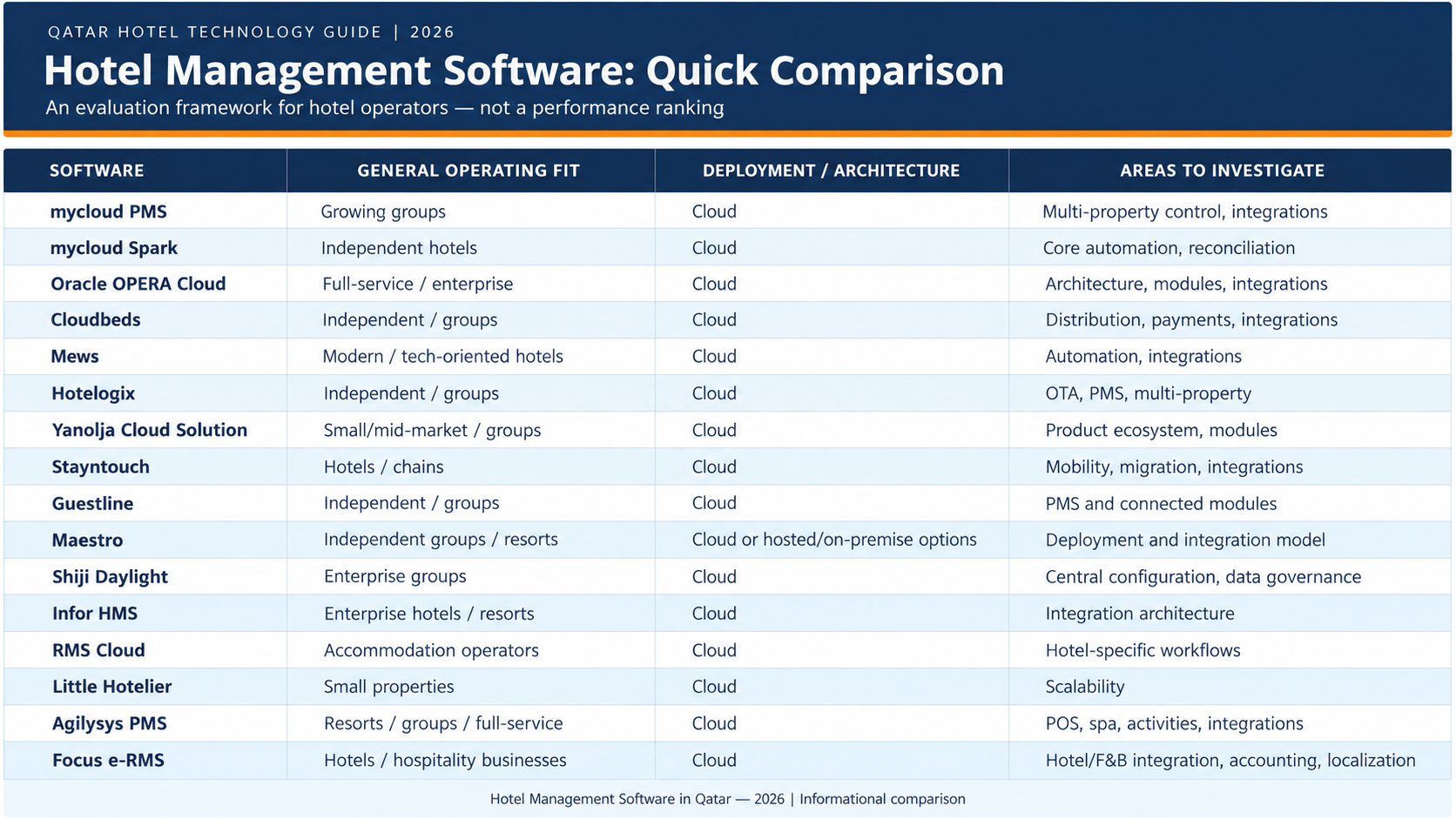
This guide examines 16 hotel management software options that may be relevant to hotels operating in Qatar. It is not a universal ranking. Different products are designed for different property sizes, operating models and technical environments. Product capabilities, pricing, integrations and availability can change, so hotels should verify the current product edition, localization, implementation scope and total cost directly with shortlisted vendors.
What Should Independent Hotels and Hotel Chains Look For?
Independent hotels in Qatar should prioritize a PMS that simplifies everyday operations, minimizes manual work and improves guest satisfaction. Essential capabilities include reservation management, housekeeping coordination, accurate billing, OTA connectivity and direct bookings. Guest profiles, loyalty features and opportunities for room upgrades, F&B upselling and cross-selling can help increase revenue while encouraging repeat stays.
Hotel chains and growing hospitality groups require a PMS that supports expansion without increasing operational complexity. Centralized reservations, shared guest and corporate profiles, consolidated KPIs, portfolio-wide reporting and role-based permissions are essential. The system should also support standardized workflows, centralized revenue visibility and seamless onboarding of new properties.
For both, reliable integrations, data security, scalability and Qatar-specific payment and accounting requirements should influence the final PMS decision.
16 Hotel Management Software Options in Qatar
The following sequence is not a ranking. Each platform is presented using the same framework: verified product scope, potential operating fit and a practical due-diligence question.
1. mycloud PMS
mycloud PMS is a complete hospitality management platform suited to hotel groups seeking a common operating layer as they grow. It combines PMS, POS, CRS, distribution, inventory, accounting, guest services and analytics, supported by 200+ interfaces and an open API. Central reporting and shared guest/company data can support portfolio visibility and consistency.
Best for: Growing hotel chains and multi-property hospitality groups in Qatar.
Smart tip: Strongest fits when corporate visibility, standardization, integrated operations and scalable multi-property control are priorities.
2. mycloud Spark
mycloud Spark targets independent, budget-conscious hotels needing core automation without an enterprise stack. The cloud platform covers PMS, POS, a built-in channel manager, reporting and digital payment capture, with a consolidated view of rates, inventory, guests and reservations.
Best for: Independent, budget-conscious hotels that need essential automation without enterprise complexity.
Smart tip: reconcile one day’s rooms, POS sales, channel bookings and payments in the demo to see how easily missed postings or leakage can be identified.
3. Oracle OPERA Cloud
OPERA Cloud is Oracle’s web-based PMS for reservations, front desk, housekeeping, billing, guest profiles, mobile work and reporting. Oracle also offers central, distribution, sales-and-events and Simphony POS products around the PMS, while the Oracle Hospitality Integration Platform provides open APIs and partner connectivity. [3]
Best for: Large, complex, upscale and multi-property hotel organizations.
Smart tip: Map the required OPERA editions, Oracle products, interfaces and implementation services before comparing total cost.
4. Cloudbeds
Cloudbeds provides a cloud hospitality platform combining PMS, payments, distribution, booking engine, guest experience and revenue-related capabilities. Its current platform documentation describes a unified data model, multi-property management, open APIs and a broad partner ecosystem.
Best for: Independent hotels, accommodation businesses and operators seeking a connected cloud platform.
Smart tip: Ask for a Qatar-specific integration list covering payment processing, accounting, distribution and any required local workflows before assessing the platform’s full fit.
5. Mews
Mews describes its platform as a cloud hospitality system covering hotel operations, booking, payments, guest experience, revenue management and integrations. Its current PMS documentation includes reservation management, housekeeping, group bookings, reporting, revenue management and multi-property capabilities. Mews also states that its ecosystem includes more than 1,000 integrations.
Best for: Technology-oriented hotels, modern operators and groups looking for extensive integrations and automation.
Smart tip: If AI or automation is important, ask what decisions are automated, what data drives them, and how employees can override or approve automated actions.
6. Hotelogix
Hotelogix provides a cloud PMS for reservations, front desk, housekeeping, billing, POS and reporting, with channel-management, direct-booking, revenue and multi-property options. The vendor maintains a Qatar-specific product guide, although buyers should still verify the exact local tax, payment, accounting and support configuration in the proposal.
Best for: Independent hotels and growing mid-market groups.
Smart tip: Separate native modules from partner products and identify who supports every connection after go-live.
7. Yanolja Cloud Solution
Yanolja Cloud Solution now presents the hotel software portfolio formerly associated with eZee under one platform. Public information covers PMS, channel management, booking engine, POS, payments, revenue tools, website services and multi-property operations; its current site also references activity in Qatar.
Best for: Independent hotels and groups comparing a connected hospitality suite.
Smart tip: Confirm current product names, plan inclusions, migration path, local support ownership and Qatar-specific connections.
8. Stayntouch PMS
Stayntouch provides a cloud-native PMS with mobile functionality for hotel and chain operations. Its documented capabilities include reservations, front-desk workflows, housekeeping, guest mobility, multi-property management, reporting and integrations. The platform is browser-based and designed to operate across modern desktop and tablet environments.
Best for: Hotels and chains prioritizing mobile operations and cloud deployment.
Smart tip: Ask the implementation team to demonstrate the exact migration process, including reservation history, guest profiles, rate plans, interfaces and staff training.
9. Guestline
Guestline provides a hospitality software platform incorporating property management, channel management, booking engine, payments and other hotel applications. Its Rezlynx PMS documentation describes reservations, guest management, billing and reporting, while the broader platform supports independent hotels and hotel groups.
Best for: Independent properties and hotel groups looking for a connected hospitality software environment.
Smart tip: Separate native PMS functions from channel-management, booking-engine and payment capabilities when calculating the total solution cost.
10. Maestro PMS
Maestro is a hotel and resort PMS available through browser and mobile interfaces, with cloud and on-premise deployment options. The vendor describes an all-in-one hospitality platform with more than 20 modules and an extensive API/integration environment.
Best for: Independent hospitality groups and properties requiring deployment flexibility.
Smart tip: If both cloud and on-premise options are presented, compare infrastructure responsibility, upgrade processes, backup arrangements and three-year ownership costs—not only the subscription price.
11. Shiji Daylight PMS
Daylight PMS is a cloud-native platform with multi-property architecture, centralized guest profiles, housekeeping, reporting, automation and open APIs. It is designed for hotel groups, while the wider Shiji ecosystem supplies adjacent hospitality products.
Best for: Luxury, upscale and enterprise multi-property hotel groups.
Smart tip: Request an architecture map separating Daylight, other Shiji products and third-party systems.
12. Infor HMS
Infor Hospitality Management Solution is a cloud hotel PMS designed for hotels, resorts and casino resorts. Its documented capabilities include centralized operations, guest profiles, housekeeping, maintenance, guest services, mobile functionality, integrations and multi-property support. Infor also describes an AWS-based multi-tenant cloud architecture.
Best for: Larger hospitality organizations requiring an enterprise-oriented operating platform.
Smart tip: Request a complete integration map covering PMS, POS, payments, accounting, revenue management and other systems before comparing it with more narrowly scoped PMS products.
13. RMS Cloud
RMS Cloud is a cloud-native property management platform serving hotels and other accommodation businesses. Its current platform information covers property management, multi-property operations, automation, reporting, direct bookings, payments, rate optimization and OTA connectivity.
Best for: Accommodation operators looking for cloud-based property management and distribution capabilities.
Smart tip: Confirm which hotel-specific workflows are supported natively if the property has complex room types, packages, group business or extensive F&B operations.
14. Little Hotelier
Little Hotelier is designed specifically for smaller accommodation businesses. The platform combines property management functionality with booking-channel connectivity, website/direct booking tools, centralized operations and mobile access. It is powered by SiteMinder and positions itself as a simpler alternative to systems designed for larger hotel operations.
Best for: Small hotels, guesthouses and accommodation businesses with relatively simple operating structures.
Smart tip: Check whether the system can handle your future operating model, not just today’s room count. Migration can become expensive if a property outgrows the PMS quickly.
15. Agilysys PMS
Agilysys PMS is a cloud property management platform designed for hotels, resorts, casinos and multi-property organizations. Its documented capabilities include reservations, front office, housekeeping, sales, finance, guest profiles, reporting, mobile workflows and integrations with other hospitality applications.
Best for: Full-service properties, resorts and multi-property hospitality businesses with broader operational requirements.
Smart tip: Map every non-room revenue stream—such as dining, spa, golf or activities—to the proposed PMS architecture and identify where data is shared between systems.
16. Focus e-RMS
Focus e-RMS is a cloud-based hospitality management platform covering hotel and restaurant operations across single or multiple locations. Its documented scope includes financial management, inventory, table reservations, shift management, reporting, billing, multi-currency support and integrated restaurant operations. The platform also provides tax-ready billing, multiple payment modes, security controls, third-party applications and RESTful APIs. Its Qatar-specific product page positions the system for hotel and restaurant operations rather than as a standalone room-reservation tool.
Best for: Hotels or hospitality businesses that need hotel operations and restaurant/F&B processes represented within a connected management environment.
Smart tip: During evaluation, test the complete data flow from room revenue and restaurant transactions through inventory, payments, accounting and management reporting. Also confirm which tax, accounting and payment configurations are included in the Qatar deployment rather than assuming that the generic product configuration applies locally.
Qatar-Specific Hotel Software Requirements
Localization should be evaluated separately from the general PMS feature list.
1. Tax and invoicing
Qatar’s General Tax Authority currently states that VAT has not been applied in Qatar. Hotels should therefore avoid assuming that a generic VAT configuration represents Qatar compliance. Qatar’s tax environment also includes income-tax and excise-tax requirements that can affect specific hotel or F&B operations.
A PMS evaluation should cover:
- Invoice configuration
- Tax and charge configuration
- Credit notes
- Cancellations
- Financial reporting
- Accounting-system integration
- Audit trails
2. Payments and reconciliation
A Qatar hotel should verify:
- Supported payment gateways
- Card processing
- Multiple currencies
- Payment reconciliation
- Refund workflows
- Chargeback handling
- Integration between payment transactions and guest folios
Do not assume that a vendor’s global payment integration automatically means a Qatar-specific payment workflow is supported.
3. Distribution
Hotels should assess:
- OTA connectivity
- Channel manager functionality
- Rate and inventory synchronization
- Direct booking engine
- GDS connectivity where required
- Regional distribution partners
- Overbooking controls
4. Guest data and privacy
Qatar has a Personal Data Privacy Protection Law, Law No. 13 of 2016. Government guidance identifies principles including transparency, data minimization, accuracy, storage limitation, integrity, confidentiality, purpose limitation and accountability.
For PMS procurement, this translates into practical questions about:
- Where guest data is stored
- Who can access it
- Role-based permissions
- Data retention
- Data export
- Deletion and correction workflows
- API security
- Audit logs
- Vendor and third-party data processing
The National Cyber Security Agency continues to publish guidance and materials relating to Qatar’s data-protection framework.
5. Operational localization
Also confirm:
- QAR support
- Arabic/English requirements where applicable
- Local date/address formats
- Accounting integration
- Guest-registration workflows
- Implementation resources
- Support availability in relevant time zones
- Data-export capabilities
For chains, the more important challenge may be standardization: ensuring every property calculates occupancy, ADR, RevPAR, revenue and guest metrics using consistent definitions.
How Much Does Hotel Management Software Cost in Qatar?
Hotel PMS pricing in Qatar varies considerably because vendors may charge based on rooms, properties, users, modules, transactions, integrations, subscription terms and implementation requirements. There is therefore no single price that applies to every hotel.
Instead of comparing subscription fees alone, buyers should evaluate the three-year total cost of ownership (TCO). This should account for implementation, data migration, staff training, integrations and channel-management fees, as well as payment processing, hardware, support, upgrades, additional properties and any custom development.
A lower subscription price does not necessarily translate into lower operating costs. Manual reconciliation between the PMS, POS, payment and accounting systems can create additional labour and operational costs. Similarly, a feature-rich platform may not be cost-effective for a smaller hotel if many of its modules are unnecessary.
The most useful comparison is therefore the total cost of running the system over time, rather than the initial subscription price alone.
How to Choose the Right Hotel PMS in Qatar?
Choosing a PMS should involve more than watching a standard product demonstration. Hotels should ask vendors to demonstrate real operating scenarios using workflows similar to their own property.
For an independent hotel, this could include managing a direct or OTA reservation, changing or cancelling a booking, processing a refund, completing check-in and checkout, applying charges, reconciling payments, updating housekeeping status, completing the night audit and generating daily management reports.
For hotel groups, the evaluation should go further. Test central reservations, consolidated reporting, shared guest and company profiles, central rate management, cross-property visibility, user permissions, financial controls and the process of adding a new property. API capabilities and data-governance processes should also be reviewed where integrations are important.
Evidence Buyers Should Request
Before signing a contract, buyers should request a current product demonstration, written module and integration lists, implementation and data-migration plans, SLA and security documentation, references from comparable hotels, and a complete commercial proposal. A three-year total cost of ownership (TCO) model can also help identify costs beyond the initial subscription.
Ultimately, PMS selection should be based on verified workflows, integration requirements, implementation capability and total cost, rather than search visibility or the length of a vendor’s feature list.
FAQs About Hotel Management Software in Qatar
Beyond software features and pricing, hotels must consider how a PMS performs during migration, daily operations and future expansion. These questions address practical challenges that independent hotels and growing hotel groups should evaluate before making a final decision.
1. How can an integrated hotel PMS improve daily workflows between front office, housekeeping, POS and finance?
An integrated PMS connects reservations, housekeeping, POS, payments and finance through shared operational data. Real-time updates reduce duplicate entries, departmental communication gaps and manual work. This helps independent hotels improve staff productivity while enabling hotel groups to maintain consistent operational workflows across multiple properties.
2. How can hotels migrate from multiple PMS platforms to one centralized system without disrupting operations?
Hotel groups should begin with data audits, standardized configurations and a structured migration plan. Testing reservations, guest profiles, deposits, integrations and financial records before go-live helps minimize disruption. Phased property migration, staff training and data validation support operational continuity while consolidating systems.
3. How can hotel groups onboard new properties without rebuilding existing PMS workflows?
A multi-property PMS can simplify onboarding by allowing new hotels to reuse existing rate structures, reservation configurations, reporting templates and user permissions. Centralized setup reduces repetitive configuration, while property-specific settings accommodate local requirements. Hotels should evaluate onboarding time, data migration and integration readiness before expansion.
4. What PMS capabilities are essential when expanding from 3 hotels to 10 or more properties?
Growing hotel groups need scalable PMS architecture supporting centralized reservations, shared guest and corporate profiles, consolidated reporting, role-based permissions and open APIs. Group-level controls, centralized rate management and portfolio dashboards help management maintain visibility and governance as the number of properties increases.
5. How can hotel groups standardize operations while maintaining flexibility for individual properties?
Hotel groups should establish common reporting definitions, guest data standards, financial controls and approval policies across properties. A flexible PMS should also accommodate property-specific pricing, packages, departmental structures and service offerings. This balances corporate governance with individual hotel requirements without imposing identical operating models everywhere.
6. How can hotel CEOs identify underperforming properties using consolidated PMS reporting and KPIs?
Consolidated PMS reporting helps hotel CEOs compare occupancy, ADR, RevPAR, revenue and operational performance across properties. Standardized KPIs highlight performance gaps, booking trends and revenue opportunities. Integration with business intelligence tools enables deeper analysis, helping management make informed pricing, staffing and investment decisions.
7. Where does revenue leakage occur when hotel groups operate disconnected PMS, POS and accounting systems?
Revenue leakage can result from missed POS postings, incorrect room rates, unrecorded charges, payment discrepancies and manual reconciliation errors. Disconnected systems reduce financial visibility across properties. An integrated PMS improves transaction tracking, revenue reconciliation and centralized reporting, helping management identify potential losses earlier.
8. How can centralized guest and corporate profiles help hotel groups increase repeat bookings and cross-property revenue?
Centralized guest profiles help hotel groups recognize returning guests, understand preferences and offer relevant room upgrades, F&B services and personalized promotions. Shared corporate profiles support consistent negotiated rates and business relationships. Connected PMS and CRM workflows encourage repeat stays and cross-property revenue opportunities.
Final Perspective
Hotel management platforms differ considerably in operating scope, architecture, localization, integration depth and intended customer profile.
A smaller independent property may prioritize simplicity, fast adoption and reliable reservation, billing and distribution workflows. A full-service hotel may need deeper POS, events, guest-service and operational integration. A growing chain may place greater importance on central reservations, portfolio reporting, common master data and standardized property onboarding.
For Qatar hotels, the most useful approach is therefore not to ask “Which PMS is the best?” but:
Which system can reliably support our current workflows, Qatar-specific requirements and future operating model at an acceptable total cost?
That answer should come from workflow testing, documented integrations, security review, implementation planning, customer references and a three-year ownership model—not from a generic “best PMS” label.
Editorial Disclosure
mycloud Hospitality publishes this guide and is included in the comparison. Competitor descriptions are based primarily on publicly available product information from official sources. The article is intended as a neutral comparison and does not constitute a universal ranking or endorsement.
Product capabilities, pricing, integrations and availability may change. Hotels should verify current information directly with shortlisted vendors before making a purchasing decision.
Information last verified: September 2026.
Editorial methodology: Product descriptions were checked against official vendor documentation where available. Qatar regulatory information was checked against government sources. No competitor has been described as “leading,” “popular” or “best” without supporting market evidence.
About The Author

Deepak Chauhan
Deepak Chauhan is responsible for marketing and positioning of “mycloud” platform and is a veteran in the hotel software industry with over 25 years’ experience giving him a strong understanding of the product requirements in the industry. He has very rare mix of working in operations of various hotels and chains for over 10 years and then co-founding a software product and service company, servicing 5 star hotels and chains for 14 years.
Deepak has led the development and marketing of cloud based hospitality systems to meet the specific, business objectives of small and mid-size properties across the globe and has worked closely with a diverse group of hoteliers and hotel technology vendors.