Choosing hotel management software in Kuwait is an operational and financial decision, not simply a technology purchase. The platform affects reservations, front-desk speed, housekeeping, payments, distribution, reporting, guest data and the ability to scale.
Independent hotels typically need accurate inventory, dependable OTA connectivity, billing controls, direct booking and easy-to-use reports. Hotel groups need those foundations plus central reservations, portfolio reporting, shared guest and company profiles, role-based controls and repeatable onboarding. This guide examines 16 options that may be relevant in Kuwait in 2026. It is not a universal ranking: buyers should verify modules, Kuwait localization, integrations, implementation and three-year ownership cost with shortlisted vendors.
In Kuwait, this due diligence is especially important because a hotel may combine international distribution platforms with local payment, accounting and support requirements. A system can look complete in a global feature list yet still require extra interfaces or implementation work for the hotel’s actual operating model. The buying process should therefore connect technology decisions to revenue control, finance reconciliation, guest-data governance and the cost of adding future properties—not just front-desk convenience.
What Should Luxury Hotels and Hotel Chains Look For?
Luxury hotels should prioritize seamless guest service, reliable front-office operations, housekeeping coordination, payments, reporting and strong integration with POS, CRM and distribution systems. The PMS should help staff recognize guest preferences and deliver consistent service without adding operational complexity.
Luxury hotel groups also need central reservations, shared guest and corporate profiles, consolidated reporting, cross-property permissions and standardized processes. They should evaluate security, data portability, API capabilities and implementation support to ensure the platform can protect service standards while scaling across multiple properties.
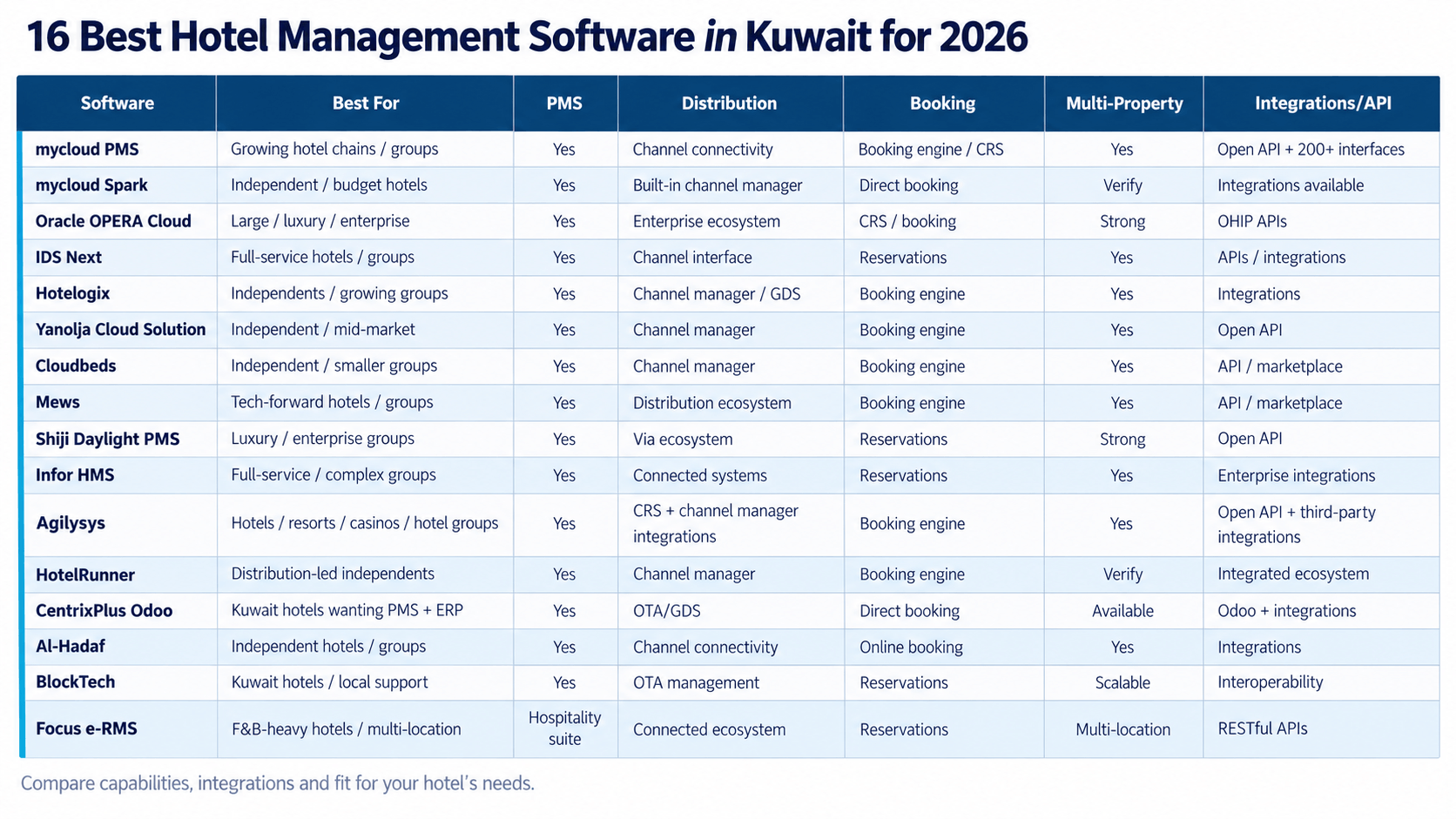
Hotel Management Software Options in Kuwait
Each entry uses the same structure: verified public scope, likely operating fit and one due-diligence test. The sequence is not a performance ranking.
1. mycloud PMS
mycloud PMS is a complete hospitality management platform suited to hotel groups seeking a common operating layer as they grow. It combines
PMS, POS, CRS, distribution, inventory, accounting, guest services and analytics, supported by 200+ interfaces and an open API. Central reporting and shared guest/company data can support portfolio visibility and consistency.
Best for: Growing hotel chains and multi-property hospitality groups in India.
Smart tip: Strongest fits when corporate visibility, standardization, integrated operations and scalable multi-property control are priorities.
2. mycloud Spark
mycloud Spark targets independent, budget-conscious hotels needing core automation without an enterprise stack. The cloud platform covers PMS, POS, a built-in channel manager, reporting and digital payment capture, with a consolidated view of rates, inventory, guests and reservations.
Best for: Independent, budget-conscious hotels that need essential automation without enterprise complexity.
Smart tip: reconcile one day’s rooms, POS sales, channel bookings and payments in the demo to see how easily missed postings or leakage can be identified.
3. Oracle Hospitality OPERA Cloud
OPERA Cloud is Oracle’s web-based PMS for reservations, front desk, housekeeping, billing, guest profiles, mobile work and reporting. Oracle also offers central, distribution, sales-and-events and Simphony POS products around the PMS, while the Oracle Hospitality Integration Platform provides open APIs and partner connectivity.
Likely fit: Large, complex, upscale and multi-property hotel organizations.
Smart tip: Map the required OPERA editions, Oracle products, interfaces and implementation services before comparing total cost.
4. IDS Next
IDS Next supplies hospitality software spanning front office, POS, housekeeping, finance, materials, banquets, central reservations and mobile guest services. Its current site names Mahaweli Reach Hotel in Kandy, providing direct evidence of use in Sri Lanka, and presents both newer FX products and the established FortuneNext suite.
Likely fit: Full-service hotels, resorts and groups needing broad operational coverage.
Smart tip: Confirm the proposed product family and which local team owns migration, integrations, tax setup and post-go-live support.
5. Hotelogix
Hotelogix provides a cloud PMS for reservations, front desk, housekeeping, billing, POS and reporting, with channel-management, direct-booking, revenue and multi-property options. The vendor maintains a Sri Lanka-specific product guide, although buyers should still verify the exact local tax, payment, accounting and support configuration in the proposal.
Likely fit: Independent hotels and growing mid-market groups.
Smart tip: Separate native modules from partner products and identify who supports every connection after go-live.
6. Yanolja Cloud Solution
Yanolja Cloud Solution now presents the hotel software portfolio formerly associated with eZee under one platform. Public information covers PMS, channel management, booking engine, POS, payments, revenue tools, website services and multi-property operations; its current site also references activity in Colombo, Sri Lanka.
Likely fit: Independent hotels and groups comparing a connected hospitality suite.
Smart tip: Confirm current product names, plan inclusions, migration path, local support ownership and Sri Lanka-specific connections.
7. Cloudbeds
Cloudbeds combines a cloud PMS with channel management, a booking engine, payments, reporting, guest-experience and revenue tools. It also provides an API and integration marketplace and serves multiple accommodation types. Its global reach makes it available for consideration in Sri Lanka, but public product scope does not by itself prove local fiscal readiness.
Likely fit: Independent hotels, boutiques, hostels and lean operating teams.
Smart tip: Require a written diagram showing how Sri Lankan tax, TDL, payments and accounting work in the proposed setup.
8. Mews
Mews is a cloud hospitality platform covering PMS, reservations, booking engine, payments, revenue tools, guest journeys, reporting and optional POS. Multi-property tools centralize portfolio management and the platform connects to a broad integration marketplace.
Best for: Digitally focused hotels and groups prioritizing automation and self-service.
Smart tip: List required integrations first, then test staff overrides, exception handling and finance outputs.
9. Shiji Daylight PMS
Daylight PMS is a cloud-native platform with multi-property architecture, centralized guest profiles, housekeeping, reporting, automation and open APIs. It is designed for hotel groups, while the wider Shiji ecosystem supplies adjacent hospitality products.
Best for: Luxury, upscale and enterprise multi-property hotel groups.
Smart tip: Request an architecture map separating Daylight, other Shiji products and third-party systems.
10. Infor HMS
Infor HMS is a cloud PMS for hotels, resorts and complex hospitality operations. It centralizes guest profiles, housekeeping, maintenance and guest services and connects with other Infor hospitality products for revenue, POS, events and analytics.
Best for: Full-service hotels, resorts and larger groups with enterprise needs.
Smart tip: Compare the architecture and implementation effort with the hotel’s actual complexity and IT capacity.
12. Agilysys
Agilysys offers cloud-based and on-premise PMS solutions for hotels, resorts, casinos and hospitality groups. It covers reservations, front desk, housekeeping, payments, reporting, guest profiles and multi-property management. The platform also supports direct bookings through Agilysys Book, CRS/channel manager integrations, POS, spa and golf operations, with open API connectivity.
Best for: Full-service hotels, luxury resorts, casinos and multi-property hospitality groups.
Smart tip: Test centralized reservations, cross-property guest profiles and POS integration, then verify Kuwait-specific payment gateways, distribution connectivity and local implementation support.
12. HotelRunner
HotelRunner provides PMS integrated with a distribution ecosystem. Current documentation covers reservations, front desk, housekeeping, cashier operations, guest relations, reports and night audit, while its booking engine and channel manager support direct and third-party sales.
Best for: Independent and boutique hotels with strong distribution needs.
Smart tip: Separate essential PMS functions from optional sales tools and compare plan-level inclusions.
13. CentrixPlus Odoo Hotel Management
Kuwait-based CentrixPlus offers Odoo hotel management covering front desk, reservations, housekeeping, maintenance, night audit and reporting. Its product page also documents OTA/GDS connectivity, direct booking, multi-currency processing and KNET integration.
Best for: Kuwait hotels wanting hospitality operations connected with ERP.
Smart tip: Identify standard Odoo, CentrixPlus-developed functions and third-party components in writing.
14. Al-Hadaf Hotel Management
Al-Hadaf offers cloud PMS with reservations, front desk, guest/corporate profiles, housekeeping, online booking, channel-manager connectivity and centralized multi-property management. Kuwait buyers should request country-specific billing, payment and support documentation.
Best for: Independent hotels through multi-property groups.
Smart tip: Request Kuwait-specific API, payment, invoice and implementation details.
15. BlockTech Hospitality Solutions
Kuwait-based BlockTech provides hospitality solutions covering PMS functions, reservations, front desk, housekeeping, billing, guest profiles, reporting and OTA channel management. Its services also include integration, customization, training and support.
Best for: Kuwait hotels valuing a locally based technology provider.
Smart tip: Create a responsibility matrix covering software, implementation, integrations, upgrades and support escalation.
16. Focus e-RMS
Focus Softnet markets Focus e-RMS in Kuwait for hospitality and restaurant operations across single or multiple locations. Public information emphasizes reservations, POS, inventory, finance, reporting, multi-currency support, security and RESTful API integrations.
Best for: Hotels with substantial F&B, outlet and multi-location requirements.
Smart tip: Verify room inventory, front office, housekeeping and hotel distribution depth alongside POS workflows.
Kuwait-Specific Hotel Software Requirements
Kuwait localization should be evaluated across tax, payments, data governance and day-to-day operations. Tax and invoice settings should be configurable and checked against current Ministry of Finance requirements for the hotel’s legal structure. The Ministry publishes Kuwait tax legislation, including income-tax rules and the domestic minimum top-up tax framework for qualifying multinational groups. Do not copy VAT, GST or tourism-levy assumptions from another GCC market without current Kuwait advice.
For payments, the Central Bank of Kuwait lists KNET as an electronic payment systems operator and maintains registers of approved electronic-payment providers. Test deposits, payment links, pre-authorizations, refunds, chargebacks, split payments, settlement reconciliation and multi-currency handling. ‘Supports payments’ is too broad to establish operational fit.
For guest data, CITRA Decision No. 26/2024 established Kuwait’s Data Privacy Protection Regulation. Hotels should understand hosting, access rights, audit trails, export options and how integrated applications process guest information. Also verify Arabic/English use where needed, KWD, accounting integrations, OTA connectivity, support coverage and any guest-registration obligations with relevant local authorities.
How Much Does Hotel Management Software Cost in Kuwait?
There is no universal market price because vendors may charge by room, property, user, module, transaction, interface, subscription period or implementation scope. Many enterprise products are quote-based.
Compare three-year total cost of ownership: subscription, implementation, migration, training, interfaces, distribution fees, payment processing, hardware, support, upgrades, new properties and custom work. A lower subscription can become expensive if employees continually reconcile disconnected systems or duplicate data manually.
How to Choose the Right Hotel PMS in Kuwait
Independent hotels should script a live demonstration: create a direct and OTA booking, move a room, cancel and refund, check a guest in/out, post an outlet charge, update housekeeping, reconcile payment, close night audit and produce the daily report.
Groups should add consolidated reporting, central reservations, shared profiles, common rates, cross-property permissions, finance outputs, API governance and a hypothetical new-property setup. Before signing, obtain a written module list, integration inventory, implementation and migration plan, SLA, security material, comparable references and a complete commercial proposal.
FAQs
What hotel workflows can a PMS automate?
A modern PMS can automate reservations, check-in and check-out, room assignment, housekeeping updates, billing, guest communication, rate distribution, reporting, and payment workflows. The best platforms reduce manual work while connecting front office, revenue, housekeeping, and guest operations.
How should hotels compare hotel management software before choosing one?
Hotels should compare operational fit, ease of use, integrations, automation, reporting, scalability, support, implementation effort, and total cost. The right PMS should solve current workflow gaps while supporting future growth, new properties, and changing technology requirements.
What should hotels compare during a hotel PMS demo?
During a PMS demo, hotels should compare real workflows rather than feature lists. Ask vendors to show reservations, check-in, billing, housekeeping, reporting, integrations, guest profiles, and exception handling using realistic scenarios relevant to the property or hotel group.
How long does it take to onboard a new hotel PMS?
Onboarding time varies by property size, data migration, integrations, and training requirements. Simple cloud PMS deployments can be relatively quick, while complex hotels or groups may require phased implementation. Ask vendors for a documented onboarding plan before signing.
How difficult is it to migrate from an existing PMS to a cloud PMS?
Migration difficulty depends on data quality, legacy system access, integrations, and operational complexity. A capable vendor should provide data-migration support, testing, staff training, and a controlled go-live process to minimize disruption during the transition.
What hotel workflows should be tested before selecting a PMS?
Hotels should test reservation creation, amendments, cancellations, check-in, room moves, billing, split payments, housekeeping updates, group bookings, corporate rates, OTA reservations, reporting, and night audit. Testing real workflows reveals whether the PMS fits day-to-day operations.
What integrations should hotels compare when evaluating PMS platforms?
Compare integrations with channel managers, booking engines, POS, payment gateways, revenue management systems, CRM, accounting, business intelligence, guest messaging, and identity systems. Also check API availability, integration depth, data synchronization, reliability, and additional integration costs.
How should hotel groups compare PMS solutions for multiple properties?
Hotel groups should compare central reservations, cross-property guest history, centralized reporting, corporate and travel-agent management, role-based access, property-level flexibility, integrations, and scalability. The PMS should simplify group oversight without limiting individual property operations.
How can I shortlist the right hotel PMS for my property?
Start by identifying operational pain points, property type, room count, integrations, reporting needs, and growth plans. Shortlist vendors that match these requirements, then compare demos, implementation support, references, pricing, scalability, and measurable business outcomes before deciding.
How does hotel software help manage corporate accounts and travel agents across a hotel group?
Hotel software can centralize corporate profiles, negotiated rates, travel-agent details, booking history, credit terms, and production data across properties. This gives hotel groups better account visibility, consistent servicing, stronger reporting, and easier management of high-value business relationships.
How do I compare hotel PMS pricing and total cost of ownership?
Compare more than the monthly subscription. Include setup, implementation, migration, training, interfaces, support, payment fees, hardware, upgrades, and future property costs. A lower headline price may become expensive if essential integrations or services are charged separately.
Final Perspective
The phrase best hotel management software in Kuwait is useful for search, but it does not imply one universal winner. A smaller independent hotel may benefit from simplicity and faster adoption, while a full-service property or growing group may need deeper integrations and stronger central controls.
The appropriate platform is the one that supports the hotel’s real Kuwait workflows, regulatory environment and future operating model at a manageable total cost. Shortlist by requirements, verify workflows in a live demonstration and document integration and support responsibilities before deciding.
Editorial Disclosure
mycloud Hospitality publishes this guide and is included in the comparison. Competitor descriptions are based on publicly available information from official vendor sources. The article is a commercial-investigation comparison, not a universal ranking or endorsement. Product capabilities, pricing, availability and implementation arrangements can change, so hotels should verify current information directly with shortlisted vendors.
Information last verified: October 2026

About The Author

Deepak Chauhan
Deepak Chauhan is responsible for marketing and positioning of “mycloud” platform and is a veteran in the hotel software industry with over 25 years’ experience giving him a strong understanding of the product requirements in the industry. He has very rare mix of working in operations of various hotels and chains for over 10 years and then co-founding a software product and service company, servicing 5 star hotels and chains for 14 years.
Deepak has led the development and marketing of cloud based hospitality systems to meet the specific, business objectives of small and mid-size properties across the globe and has worked closely with a diverse group of hoteliers and hotel technology vendors.