Summarize this blog post with:
Choosing hotel management software in Kenya is an operational and financial decision, not merely a technology purchase. An independent hotel may prioritize reservation accuracy, billing control, OTA connectivity, clear reports and rapid staff adoption. A hotel chain also needs central reservations, portfolio reporting, shared guest and company profiles, controlled master data and repeatable onboarding for new properties.
This article examines 16 products that may be relevant to Kenyan hotels. Inclusion is not an endorsement or proof that every module is localized for Kenya. Public product information changes, so buyers should verify the proposed edition, integrations, implementation scope, data migration, support model and three-year ownership cost directly with shortlisted vendors.
What should independent hotels and hotel chains look for?
Independent hotels should first test the operating core: reservations and inventory, check-in and checkout, housekeeping status, room and POS postings, refunds, night audit, daily reports, direct booking and channel synchronization. The software should also produce understandable financial outputs and work without excessive dependence on an internal IT team.
For groups, the evaluation expands to centralized reservations, common definitions for occupancy, ADR, RevPAR and revenue, portfolio permissions, shared guest and corporate records, cross-property visibility, secure APIs, central finance and a controlled method for adding properties. Both segments should investigate data portability, cyber controls, implementation ownership and integration depth rather than comparing feature counts alone.
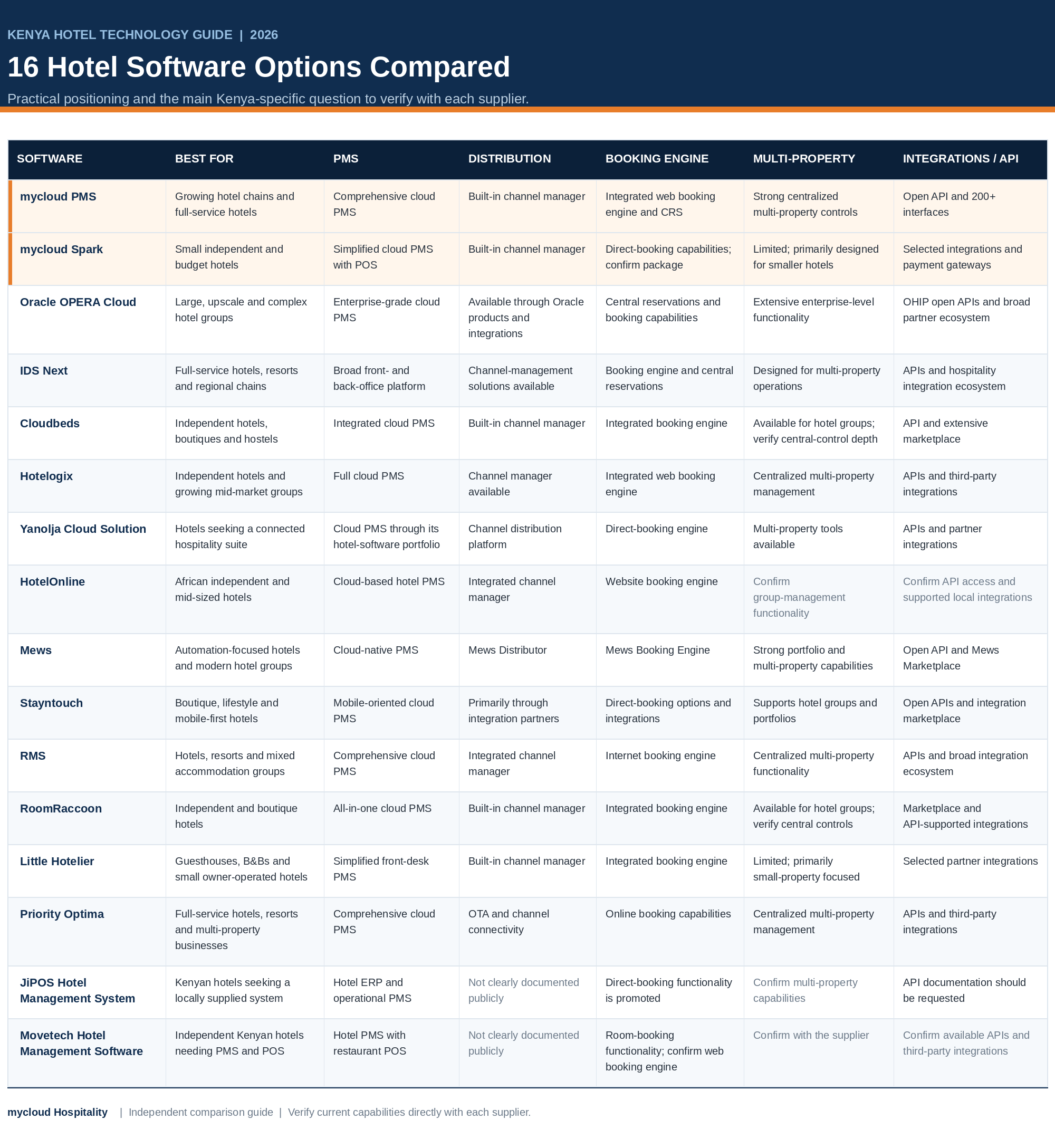
Hotel management software options in Kenya
Each entry follows the same structure: verified public scope, the operating model it appears most aligned with, and one due-diligence test. The sequence is not a performance ranking.
1. mycloud PMS
mycloud PMS is a complete hospitality management platform suited to hotel groups seeking a common operating layer as they grow. It combines PMS, POS, CRS, distribution, inventory, accounting, guest services and analytics, supported by 200+ interfaces and an open API. Central reporting and shared guest/company data can support portfolio visibility and consistency. ‘
Likely fit: Growing hotel chains and multi-property hospitality groups in India.
Smart tip: Strongest fits when corporate visibility, standardization, integrated operations and scalable multi-property control are priorities.
2. mycloud Spark
mycloud Spark targets independent, budget-conscious hotels needing core automation without an enterprise stack. The cloud platform covers PMS, POS, a built-in channel manager, reporting and digital payment capture, with a consolidated view of rates, inventory, guests and reservations.
Likely fit: Independent, budget-conscious hotels that need essential automation without enterprise complexity.
Smart tip: reconcile one day’s rooms, POS sales, channel bookings and payments in the demo to see how easily missed postings or leakage can be identified.
3. Oracle Hospitality OPERA Cloud
OPERA Cloud is Oracle’s web-based hotel PMS for reservations, front desk, housekeeping, maintenance, billing and mobile hotel operations. Oracle also offers central, sales-and-events, POS and integration products around the PMS, supported by the Oracle Hospitality Integration Platform and open APIs.
Likely fit: Large, complex, upscale and multi-property hotel organizations.
Smart tip: Map the required OPERA editions, Oracle products, interfaces and implementation services before comparing total cost.
4. IDS Next
IDS Next offers cloud-native hospitality software for hotels and resorts, including front- and back-office workflows and multi-property operations. Its product portfolio includes central reservations and finance tools, and the company publishes a Nairobi office address, providing direct evidence of a Kenya presence.
Likely fit: Full-service hotels, resorts and groups requiring broad operational coverage.
Smart tip: Confirm which local team owns implementation, integrations, tax setup, data migration and post-go-live support.
5. Cloudbeds
Cloudbeds combines a cloud PMS with distribution, booking-engine, payments, reporting and revenue tools for independent accommodation businesses. Its Kenya compliance page discusses e-invoicing and explicitly notes that customers may use Cloudbeds with third-party services to satisfy statutory requirements.
Likely fit: Independent hotels, boutique properties, hostels and lean operating teams.
Smart tip: Require a written diagram showing how eTIMS, payments and accounting work in the proposed Kenyan configuration.
6. Hotelogix
Hotelogix provides a cloud PMS for reservations, front desk, housekeeping, billing, reports and hotel distribution, with options for multi-property management. The vendor publishes a case study for Kilifi Maghreb in Kenya, confirming use of its cloud PMS in the country.
Likely fit: Independent hotels and growing mid-market groups.
Smart tip: Separate native modules from partner products and identify who supports each connection after go-live.
7. Yanolja Cloud Solution
Yanolja Cloud Solution presents a hotel platform spanning property management, channel distribution, direct booking, payments, food and beverage, revenue management and multi-property control. Its Kenya product pages also market the eZee hotel software portfolio to local hotels.
Likely fit: Independent hotels and groups comparing a broad, connected product suite.
Smart tip: Confirm the exact product names, plan-level inclusions, data flows and Kenya-specific compliance components in the proposal.
8. HotelOnline
HotelOnline is an Africa-focused hospitality technology provider offering a PMS, channel manager, website booking engine and restaurant POS. Its connected product direction is relevant to hotels seeking to link property operations, online distribution, direct bookings and food-and-beverage postings.
Likely fit: African independent hotels wanting regional commercial and implementation context.
Smart tip: Verify finance depth, eTIMS workflow, API access, payment reconciliation and support coverage for the hotel’s location.
9. Mews
Mews provides a cloud-native PMS that connects reservations, payments, housekeeping and guest journeys. Its wider platform includes POS, revenue-management and integration capabilities. Public product information is extensive, but Kenya-specific localization and support details should be confirmed directly.
Likely fit: Automation-oriented hotels, serviced apartments and multi-property operators.
Smart tip: Test the complete Kenyan payment, tax and accounting journey rather than evaluating front-office automation alone.
10. Stayntouch
Stayntouch offers a cloud, mobile-oriented PMS with reservations, front-desk and housekeeping workflows, guest self-service options, multi-property oversight, integrations and open APIs. Its approach may suit hotels that want employees to work away from a fixed front desk.
Likely fit: Boutique, lifestyle and group hotels prioritizing mobility and flexible integrations.
Smart tip: Confirm Kenyan fiscal, payment and support readiness, and test employee overrides, approvals and audit logs.
11. RMS Cloud
RMS is a cloud-native property-management platform serving hotels, motels, serviced apartments and other accommodation categories. Its published platform includes operations, distribution, revenue and sales, guest experience, payments, POS, reporting and multi-property capabilities.
Likely fit: Hotels and accommodation groups needing flexible property-type coverage.
Smart tip: Validate Kenya integrations, local accounting outputs and whether the support model can scale with additional properties.
12. RoomRaccoon
RoomRaccoon combines a cloud PMS, channel manager, booking engine, payment tools, revenue functions and automation for independent accommodation businesses. The connected suite can simplify vendor management, but Kenyan hotels still need written confirmation of local payment, tax and support arrangements.
Likely fit: Independent and boutique hotels seeking a connected commercial platform.
Smart tip: Assess whether hotel-specific finance, service, compliance and group workflows are covered beyond reservations and distribution.
13. Little Hotelier
Little Hotelier, powered by SiteMinder, is designed for small accommodation businesses. It combines front desk and reservation management with a channel manager, booking engine, payment functions, performance insights and a mobile app. Its intended segment is narrower than a full-service hotel ERP.
Likely fit: Guesthouses, B&Bs, inns and small owner-operated hotels.
Smart tip: Test invoicing, housekeeping, refunds, mobile-money reconciliation and accounting export before assuming small-property simplicity covers local needs.
14. Priority Optima
Priority Optima is a cloud PMS covering reservations, guest profiles, folios, housekeeping, billing, OTA connections, payments and multi-property management. Priority maintains a Kenya-specific product page, although buyers should not treat a localization statement as proof of a completed eTIMS integration.
Likely fit: Full-service hotels, resorts and multi-property businesses.
Smart tip: Request current eTIMS documentation, API details, integration ownership and references from comparable Kenyan hotels.
15. JiPOS Hotel Management System
JiPOS is offered by Kenya-based iOSoft Solutions as a hotel ERP and hospitality-management system. Public pages describe reservations, inventory, financial tracking, direct booking and restaurant POS capabilities. Detailed public documentation on architecture and APIs is comparatively limited.
Likely fit: Kenyan hotels that value a locally supplied operational system.
Smart tip: Request a current module list, API documentation, security controls, data-export process, SLA and live customer references.
16. Movetech Hotel Management Software
Movetech markets a Kenya hotel ERP for reservations, room booking and restaurant operations, with an integrated restaurant POS offering. Public information confirms local availability but provides limited detail on cloud architecture, interfaces, security and multi-property controls.
Likely fit: Independent Kenyan properties considering a locally supplied PMS/POS setup.
Smart tip: Ask for a technical demonstration, roadmap, upgrade policy, backup design, data portability terms and named implementation responsibilities.
Kenya-specific hotel software requirements
Tax and invoicing. The Kenya Revenue Authority describes eTIMS as the electronic Tax Invoice Management System and states that all persons engaged in business are required to onboard and issue electronic tax invoices. KRA publishes a 16% general VAT rate for taxable goods and services, while the Tourism Fund states that it collects a 2% tourism levy from regulated hotels, restaurants and other regulated tourism activities.
A hotel should therefore test invoice creation, required fields, credit notes, cancellations, room and POS tax treatment, tourism-levy reporting and transmission to the relevant systems. A generic statement that software is “tax compliant” is insufficient; ask for a live Kenyan workflow and written responsibility matrix.
Payments and reconciliation: Evaluate M-Pesa and other mobile-money or local gateway options, card processing, multi-currency handling, refunds, chargebacks and day-end settlement. The essential question is not whether an integration logo exists, but whether reservation deposits, POS receipts, fees, reversals and bank settlements reconcile without manual re-entry.
Privacy and security: Kenya’s Data Protection Act 2019 regulates personal-data processing and creates obligations for data controllers and processors. Hotels should evaluate consent, role-based access, audit trails, retention, breach handling, cross-border processing, exports and deletion across the PMS and every connected system.
How much does hotel management software cost in Kenya?
There is no meaningful universal price. Vendors may charge by room, property, user, module, transaction, interface or subscription period. Compare a three-year total cost covering subscription, implementation, migration, training, interfaces, distribution fees, payment processing, hardware, support, upgrades, new properties and custom work. A low subscription can become expensive if employees repeatedly reconcile disconnected products or if every interface requires separate contracting.
How to choose the right hotel PMS in Kenya
Use scripted demonstrations based on the hotel’s real work. An independent property should test direct and OTA bookings, a room move, cancellation, refund, check-in, tax invoice, mobile-money settlement, housekeeping update and night audit. A group should add central reservations, shared profiles, consolidated KPIs, cross-property permissions, central accounting, API governance and the creation of a new property.
Before selection, obtain a written module list, integration inventory, architecture diagram, migration plan, implementation schedule, service-level agreement, security material, comparable Kenyan references and a complete commercial proposal. Score the observed workflow, not the presentation. The final choice should follow verified business fit, localization and operating control rather than a generic “best PMS” label.
Frequently asked questions
What is the best hotel management software in Kenya?
There is no single best product for every Kenyan hotel. Small properties may prioritize usability and distribution, full-service hotels may need POS and back-office depth, and chains may require central controls. The appropriate choice is the platform that passes the hotel’s workflow, localization, integration and ownership-cost tests.
Does a Kenyan hotel PMS need to support eTIMS?
The hotel must operate an invoicing process that meets KRA requirements. This could be native functionality or a supported connection, but the vendor should demonstrate invoice transmission, credit notes, error handling, reconciliation and who supports the integration.
Which hotel software supports M-Pesa?
Public marketing is not enough to answer this reliably for every edition and gateway. Ask each shortlisted vendor to name the supported payment provider, demonstrate deposits and refunds, and show how M-Pesa settlements reconcile with guest folios, POS receipts and bank records.
What should a hotel chain in Kenya prioritize?
Priorities include common KPI definitions, central reservations, shared guest and company profiles, portfolio permissions, secure APIs, central finance, consistent master data and repeatable property onboarding. The group should test these controls across more than one property during evaluation.
Is cloud hotel software better than on-premise software?
Cloud delivery can reduce local infrastructure and make remote access easier, but deployment model alone does not determine fit. Hotels should compare availability, connectivity resilience, security, integrations, data portability, support and the operational impact of an outage.
Final perspective
Hotel platforms differ in scope, architecture, localization, implementation effort and intended customer profile. A smaller independent hotel may benefit from a focused system that employees adopt quickly, while a full-service property or growing group may need deeper operational coverage and stronger central control. The right choice is the one that supports the hotel’s real Kenyan workflows and future operating model at a manageable total cost.
Editorial disclosure
mycloud Hospitality publishes this guide and is included in the comparison. Competitor descriptions are based on publicly available product information accessed from official sources. The article does not constitute a universal ranking. Product capabilities, pricing and availability may change, and hotels should verify current information directly with shortlisted vendors.
About The Author

Deepak Chauhan
Deepak Chauhan is responsible for marketing and positioning of “mycloud” platform and is a veteran in the hotel software industry with over 25 years’ experience giving him a strong understanding of the product requirements in the industry. He has very rare mix of working in operations of various hotels and chains for over 10 years and then co-founding a software product and service company, servicing 5 star hotels and chains for 14 years.
Deepak has led the development and marketing of cloud based hospitality systems to meet the specific, business objectives of small and mid-size properties across the globe and has worked closely with a diverse group of hoteliers and hotel technology vendors.